
When your website is invisible on Google, your business pays the price every single day.
What Is Your Biggest SEO Challenge? Low Traffic, No Leads, Poor Google Ranking Explained
You built a website. You hired someone to "do SEO." You waited. And then… nothing. No calls. No inquiries. No sales. Just silence.
That's not bad luck. That's a broken strategy. And if your website sits somewhere on page 2 or 3 of Google right now, the hard truth is that you're practically invisible. Organic search results account for 94% of all clicks — and almost none of those clicks ever reach page 2. Your competitors, many of whom are worse at what they actually do, are eating your lunch because they show up and you don't. AIOSEO
The good news? Every single SEO problem your business is facing right now has a documented, proven cause. And once you know the cause, you can fix it. Let's cut through the noise.
Why SEO Feels Broken for Most Businesses Right Now
Search in 2026 is not what it was three years ago. The ground shifted. Gartner predicted that traditional search engine volume would drop 25% by 2026, with search marketing losing market share to AI chatbots and virtual agents — and that prediction is landing right on schedule. circle S studio
According to KEO Marketing, 73% of B2B websites saw significant traffic losses between 2024 and 2025, with an average 34% year-over-year decline. If your traffic dropped and you didn't change anything on your site, you're not imagining it. The rules changed around you. Search Engine Land
Here's what's actually happening across the industry right now:
Nearly 60% of Google searches now end without a single click — users get their answer from AI Overviews and never visit any website. GoodFirms
40% of marketers cite algorithm changes as their single biggest SEO challenge. AIOSEO
AI Overviews now appear in 89% of brand search results, reshaping how businesses get found. GoodFirms
In January 2025, only 6% of consumers used ChatGPT to find local businesses. By January 2026, that number hit 45%. Connectica
News publishers saw Google referrals drop 33% globally in the 12 months ending November 2025 — and non-media businesses aren't far behind. Search Engine Land
"The businesses that suffer most aren't the ones with bad products. They're the ones with good products and invisible websites." — A pattern we see on repeat at The Nexora Digital.
Understanding these shifts is step one. But knowing which specific challenge is killing your rankings? That's where the real work begins.
The 7 Biggest SEO Challenges Businesses Actually Face (And What Causes Them)
1. Low Organic Traffic — The Visibility Problem Nobody Talks Honestly About
Most business owners assume low traffic means they need more content. That's almost never the root cause.
Google has accelerated its core update cadence through 2025 and 2026, with each update raising the bar for content quality. The March 2025 core update specifically targeted AI-generated content that lacks genuine expertise signals, thin content built around keyword density rather than user value, and pages with poor E-E-A-T signals. UpGrowth
If your website has pages stuffed with generic information that doesn't reflect real expertise, Google is quietly demoting you. Not penalizing you with a manual action — just quietly pushing you down until you're gone. The businesses that recovered fastest from these updates were the ones that added first-person experience, original data, and real author authority to their pages.
The fix isn't writing more. It's writing better, with more specificity and more provable credibility.
2. Poor Google Rankings — You're Targeting the Wrong Keywords
Here's a mistake we see constantly: businesses target keywords that are simply out of their reach. They write a page about "digital marketing agency" and wonder why they can't outrank HubSpot or Forbes.
Long-tail keywords make up 91.8% of all Google searches. In 2026, targeting them is the fastest path to organic rankings because short-tail terms are dominated by high-authority domains. W3era
If you're a new or mid-size business, competing on broad, high-volume keywords is like a local café trying to outspend Starbucks on TV advertising. The smarter play is to own the specific, high-intent searches that your exact buyer types in — the ones your competitors have ignored.
Keyword Type | Example | Difficulty | Conversion Rate |
|---|---|---|---|
Short-tail (avoid) | "SEO agency" | Very High | Low |
Mid-tail (competitive) | "SEO agency for small business" | High | Medium |
Long-tail (target first) | "why is my website not getting traffic 2026" | Low–Medium | High |
Question-based (win this) | "how to fix poor Google ranking for my business" | Low | Very High |
Filtering for keywords with a difficulty score under 30 and clear search intent is the single most reliable way to start ranking faster without a massive backlink budget. W3era
3. No Leads from Website Traffic — The Conversion Gap
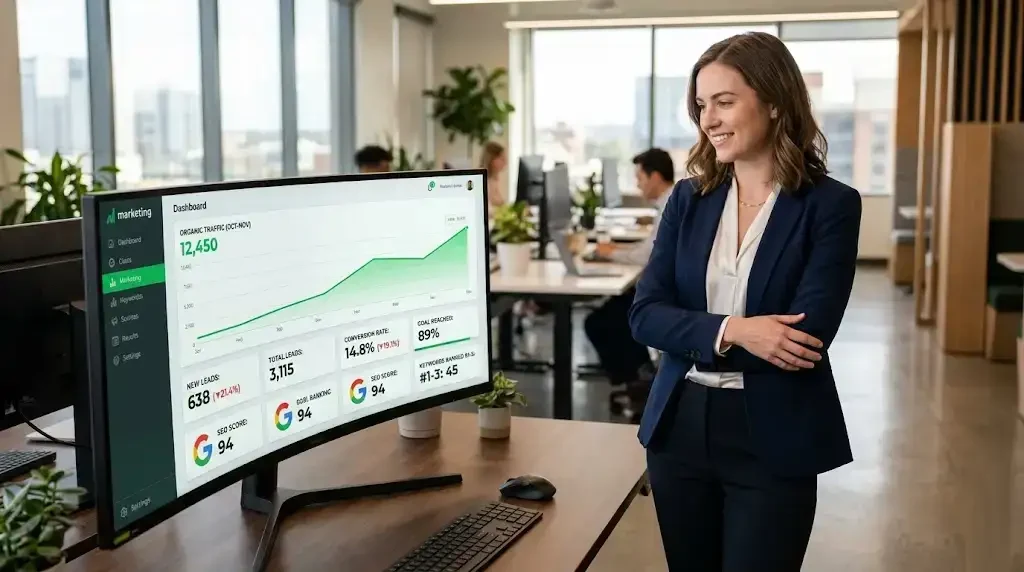
This one is sneaky. Some businesses actually have decent traffic — but the phone never rings. The form never fills. The WhatsApp never pings.
Traffic without leads means one of three things: you're attracting the wrong audience, your website fails to communicate value fast enough, or there's no clear next step for the visitor to take. Most websites greet visitors with vague headlines like "Welcome to Our Company" and expect people to figure out what to do next.
Publishers who excelled at converting visitors — regardless of traffic source or volume — demonstrated far greater revenue resilience than those focused purely on traffic acquisition. The lesson applies equally to every business website. The Digital Bloom
Your SEO should target buyer-intent searches, not just informational ones. Someone searching "best SEO agency in Islamabad" is ready to talk. Someone searching "what is SEO" is not. Both are valid — but only one drives leads this week.
4. Algorithm Updates — The Constant Gut Punch
One morning your rankings are fine. Next Monday they've collapsed. No warning. No explanation. You didn't change anything. Google did.
The challenge in 2026 isn't whether teams can publish content — it's whether they can consistently deliver content quality that earns trust, visibility, and long-term impact. Brands face growing pressure to differentiate on expertise, originality, and credibility rather than volume. HubSpot
Algorithm updates punish shortcuts. If your site's content was ever built around keyword density, low-effort AI generation, or backlink schemes, each new update is another opportunity for Google to catch up with you. The businesses that survive every update are the ones that never tried to game the system in the first place.
The practical response is to audit your existing content quarterly. Identify pages with high impressions but low clicks — those are your warning signs. Update them with real depth, original insight, and genuine author expertise before the next update hits.
5. Low Sales from SEO — The "We Rank But Nobody Buys" Problem
Ranking on page one feels like the finish line. But for many businesses, it turns out to be just the starting gun.
The most common reason for ranking without sales is a mismatch between keyword intent and commercial readiness. If someone finds your site through an informational post and lands on a page with no clear offer, no trust signals, and no reason to act right now — they leave. And Google notices that bounce rate.
Your SEO strategy and your sales funnel must talk to each other. Content that ranks for awareness keywords should warm leads and guide them toward decision-stage pages. If you treat every ranking keyword as a sales opportunity, you'll lose the visitor. If you build a logical content journey that meets buyers at each stage, SEO becomes your best-performing sales channel.
6. Technical SEO Issues — The Silent Killers Nobody Sees
You can write the world's best content and still rank nowhere if your website has technical problems that prevent Google from properly crawling and indexing it.
The most common technical regressions in 2026 include accidental noindex tags pushed during deployments, broken internal links from URL structure changes, and crawl errors introduced during CMS updates or plugin changes — often silently deindexing pages over weeks. UpGrowth
Most business owners have no idea these issues exist. Their developer "fixed the website" six months ago and nobody checked whether Google can still find and read every important page. A single misconfigured tag can wipe months of SEO progress overnight.
Technical SEO covers site speed, mobile usability, Core Web Vitals, structured data markup, XML sitemaps, canonical tags, and crawl budget management. These aren't optional. They're the foundation everything else sits on.
7. Zero-Click Search & AI Overviews — The Newest Challenge Most Businesses Are Ignoring
This is the challenge nobody warned you about — and it's hitting businesses hard right now.
Google's AI Overviews now appear in 44.4% of all search queries, and they reduce clicks by 58% when they appear. That means even if you rank #1, a significant portion of searchers get their answer directly from Google's AI summary and never visit your site. Connectica
65% of marketers now cite AI-driven search changes as their single biggest challenge, according to Goodfirms' 2026 survey of over 100 digital marketing practitioners across 20+ countries. GoodFirms
The response isn't to give up on organic search. It's to structure your content so AI systems cite you as their source. When you become the reference that Google's AI pulls from, your brand gets visibility even in zero-click searches. That's the new game — and it rewards exactly the same things that always mattered: genuine expertise, clear answers, and trustworthy content.
How to Diagnose Which SEO Challenge Is Actually Hurting You
Not every business faces every problem. The pattern matters. Here's a quick self-diagnosis:
Symptom You See | Most Likely Root Cause | First Action |
|---|---|---|
Website gets no traffic at all | Wrong keywords, poor technical SEO | Run a site audit + keyword gap analysis |
Traffic exists but rankings dropped | Algorithm update hit | E-E-A-T content audit, update thin pages |
Rankings are fine but no one contacts you | Wrong intent keywords, poor CTA design | Map content to buyer journey stages |
You rank but get no sales | Disconnect between SEO and sales funnel | Create decision-stage landing pages |
Sudden traffic drop with no change made | Technical issue or penalty | Check Google Search Console immediately |
Competitors outrank you despite worse content | They have stronger backlinks and authority | Start a strategic link-building campaign |
Work through this table honestly. Most businesses discover their real problem is different from what they assumed — and that's actually the best news, because a correctly identified problem is already halfway solved.
What Actually Works in 2026: The Non-Negotiables
Here's what the data consistently confirms works, regardless of algorithm changes:
Build topical authority — Cover your subject area deeply across multiple, interlinked pages instead of publishing isolated posts.
Target buyer-intent long-tail keywords — Specific, lower-competition phrases that reflect what ready-to-act searchers actually type.
Demonstrate real E-E-A-T — Add author credentials, original data, first-person experience, and verifiable expertise to every important page.
Fix the technical foundation — Site speed, mobile usability, crawlability, and structured data are non-negotiable in 2026.
Structure content for AI Overviews — Answer questions directly, use clear headings, and provide the kind of specific, citable facts that AI systems pull from.
Diversify beyond Google — A healthy traffic mix in 2026 might be 30% organic, 20% direct and email, 20% social, 15% referral, and 15% paid — rather than the 60–70% organic dependence that was common just a few years ago. Knihter
Measure leads and revenue, not just rankings — A page that ranks #4 but generates consistent leads beats a #1 ranking that converts nobody.
HubSpot's State of Marketing report found that in 2025, 65% of companies exceeded their marketing performance goals, with less than 9% falling short — which tells you that SEO still works. The businesses hitting those targets aren't doing anything magical. They're doing the fundamentals correctly and consistently. HubSpot
What The Nexora Digital Does Differently
At The Nexora Digital, we don't diagnose your SEO with a checklist tool and deliver a 40-page PDF you'll never read. We start by understanding why your specific site isn't performing — not why websites in general struggle.
Every business has a different bottleneck. Some need keyword strategy rebuilt from scratch. Some need content that actually reflects their expertise. Some have a technical issue quietly strangling every page on their site. We find the real problem first, then we fix it — in the order that produces results fastest.
If your website is generating low traffic, no leads, poor rankings, or weak sales, the answer isn't to wait for things to improve on their own. They won't. Search is evolving faster than most businesses can keep up with alone — and the gap between businesses with the right SEO strategy and those without it is widening every month.
Ready to find out exactly what's holding your website back? Talk to The Nexora Digital today — and let's build the kind of SEO presence that actually grows your business.